Let me guess how your workday goes. You sit down at your desk around nine, tell yourself you’ll take a walk at lunch, and then suddenly it’s four in the afternoon, your lower back has filed a formal complaint, and the only steps you’ve taken were the eight it took to refill your coffee. I know, because that was me for the better part of two years.
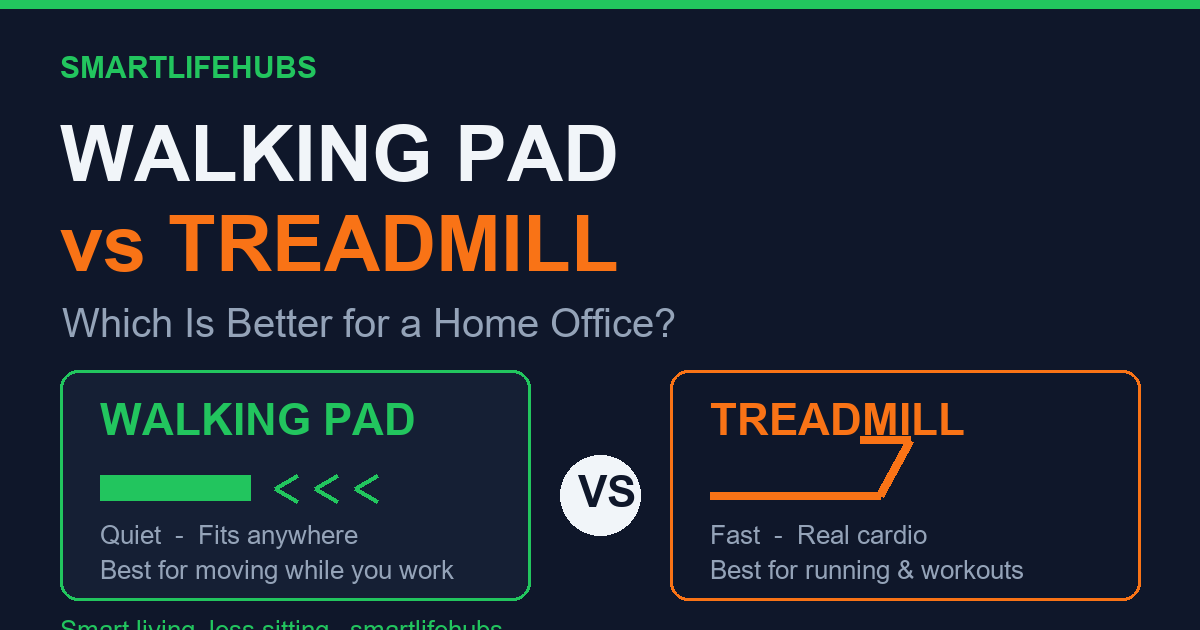
When I finally decided to do something about the slow petrification of my spine, I went down the rabbit hole everyone goes down: should I get a treadmill, or one of those flat walking-pad things I keep seeing in videos of people typing while strolling?
They look similar in a screenshot. They are not the same animal. And if you work from home, the difference matters a lot more than the price tag suggests. So let’s actually compare them — not the way a spec sheet would, but the way someone who’s owned both and regretted at least one of them would.
First, what are we even talking about?
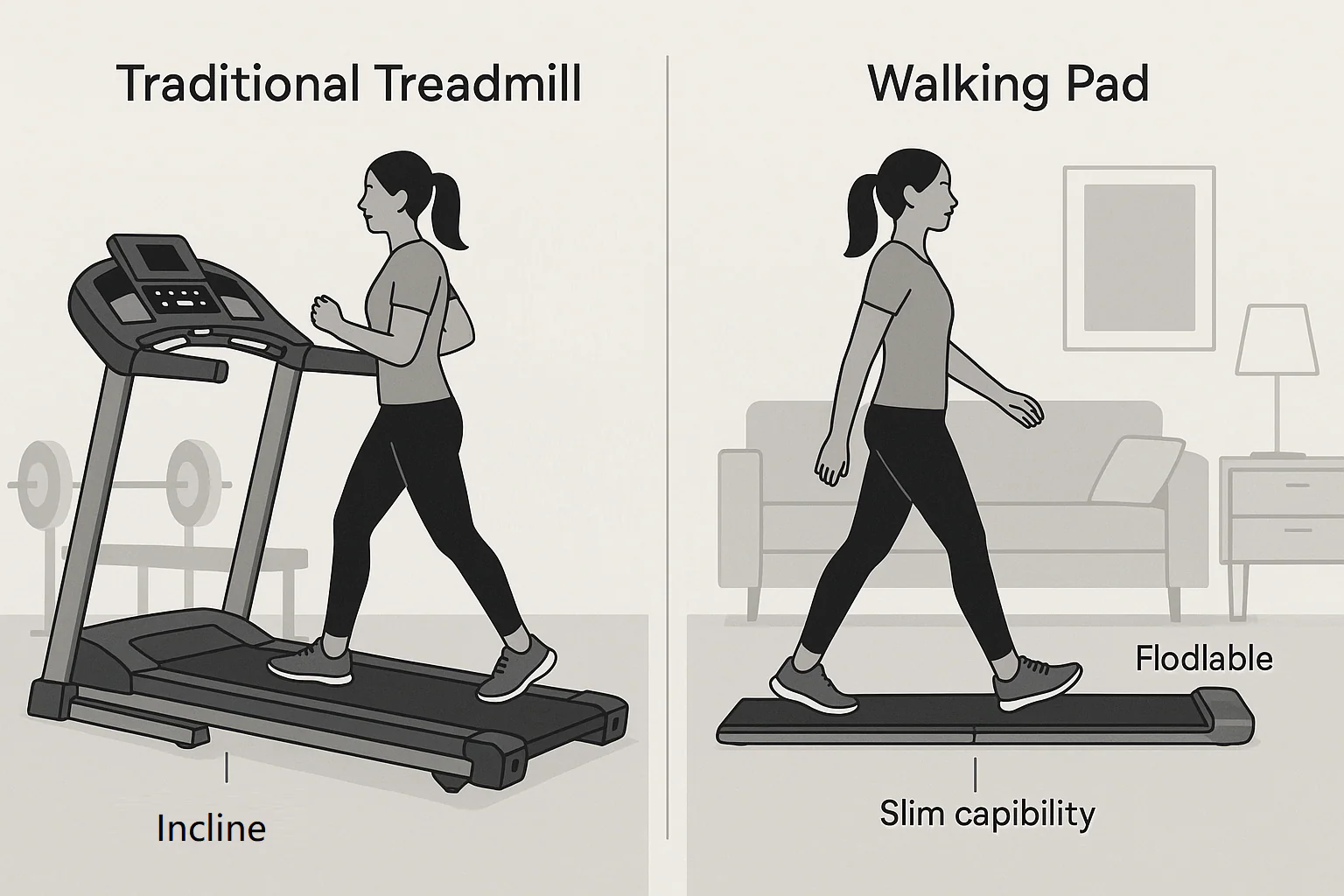
A treadmill is the classic gym machine. A belt, a motor, side rails to hold onto, an incline setting, and — on the nicer ones — a screen that judges your heart rate. It goes fast. You can run on it. It’s loud, it’s big, and it means business.
A walking pad (sometimes called an under-desk treadmill) is the treadmill’s quiet, minimalist cousin. It’s low to the ground, usually without handlebars, capped at a walking speed (roughly 1–4 mph), and slim enough to slide under a sofa or bed when you’re done. You’re meant to use it while you work — slow steps, laptop open, meeting muted.
That single design difference — made to use while you sit-and-type vs. made to exercise — is the whole story.
The quick comparison
| Walking Pad | Treadmill | |
|---|---|---|
| Top speed | ~1–4 mph (walk only) | Up to 10+ mph (walk to sprint) |
| Size | Slim, slides under furniture | Large, needs dedicated space |
| Noise | Quiet (brushless motors) | Louder, especially running |
| Handlebars | Usually none | Yes |
| Incline | Rare / fixed | Often adjustable |
| Best for | Slow movement during work | Real cardio, running, workouts |
| Price range | $150–$400 | $300–$2,000+ |
| Storage | Easy | Hard |
If you only remember one row from that table, make it the “best for” one. Everything else follows from it.

When a walking pad is the better choice
You should probably get a walking pad if your real problem is not moving, not not exercising. Those sound the same. They aren’t.
A walking pad solves the specific curse of the home office: you sit for eight hours and feel guilty about it. It lets you accumulate steps while answering email, sitting in Zoom calls (camera off, naturally), or reading reports. You’re not getting a killer workout. You’re not burning a dessert. What you are doing is keeping your blood from pooling in your ankles and your brain from turning to oatmeal by 2 p.m.
The things people love about them:
- They disappear. I slide mine under the couch. My apartment doesn’t look like a gym, which matters when your office is also your living room.
- They’re quiet enough. Brushless motors hum rather than roar. Nobody on your calls hears the thunder of a sprint.
- Low commitment. Because it’s right there, you actually use it. The treadmill in the corner becomes a clothes rack; the walking pad under your feet becomes a habit.
- Gentle on the body. At 2 mph you’re strolling, not training for a marathon. Knees stay happy.
The honest downside: you will not get your heart rate into any kind of danger zone. If your goal is weight loss through sweat, a walking pad alone is whisper-soft on the calories. It’s a movement tool, not a fitness tool.
When a treadmill is the better choice
Get a treadmill if you actually want to work out — run, do intervals, hit a target heart rate, sweat through a shirt. A walking pad physically can’t do this; it tops out where a treadmill is just warming up.
A treadmill earns its floor space if:
- You’re training for something (a 5K, general cardio health with intensity).
- You want incline walks, which are quietly one of the best low-impact fat-burners around.
- You don’t mind a machine that announces its presence in the room.
- You have a spare room, garage, or corner that can be permanently “the gym corner.”
The catch is the catch we all hit: a full treadmill in a home office is a relationship test. It’s big. It’s loud when you run. And the data is brutal — most home treadmills get used hard for three weeks and then become the most expensive towel rack in the house. If you’ve done that before, be honest with yourself before buying another.
The thing nobody tells you: you can’t really type and walk
I need to be straight with you, because the videos lie. In those clips, someone glides along at a brisk pace while flawlessly drafting a novel. In real life, typing while walking takes about two weeks of awkward practice, and even then, anything requiring precision — spreadsheets, design work, careful editing — gets worse before it gets better.
What does work beautifully on a walking pad:
- Voice calls where you’re mostly listening.
- Reading and reviewing documents.
- Brainstorming, listening to podcasts, light email triage.
- Walking meetings (phone in hand, camera off).
So the walking pad isn’t a replacement for focused desk work. It’s a way to keep moving during the low-intensity parts of your day. Set it at 1.5–2 mph, and after a week it feels weird to sit still.
My actual recommendation
If you work from home and you’re choosing between the two, here’s the simple version:
Pick a walking pad if you want to move more without disrupting your day, you have limited space, and your fitness is “I just don’t want to feel like a statue by Friday.” This is the right answer for maybe 80% of home-office workers, and it’s the one I use daily.
Pick a treadmill if you want structured cardio, you plan to run, and you have a fixed space that can stay a gym. Buy it for workouts, not for “while I work” — those are different use cases and the treadmill loses the second one every time.
And if you’ve got the room and the budget, the dream setup some people land on is both: a walking pad for slow work-day movement, and a real treadmill (or outdoor runs) for actual exercise. But start with one. Starting with one is how you actually start.
A few buying notes so you don’t waste the money
- For walking pads: look for a brushless motor (quieter, longer-lived), a remote or app speed control, and a weight rating comfortably above yours. Skip the cheapest no-name units — the deck squeaks and the belt drifts within a month.
- For treadmills: a continuous-duty horsepower (CHP) of at least 2.0 for walking, 2.5+ if you’ll run; a deck that folds if space is tight; and a warranty that covers the motor for several years.
- Measure first. I almost bought a walking pad that wouldn’t fit between my desk and the wall. Tape the dimensions on your floor before you click “buy.”
FAQ
Can you run on a walking pad? No, and you shouldn’t try. They’re speed-capped and have no side rails or shock absorption for running. That’s what treadmills are for.
Is a walking pad worth it for weight loss? It helps, but gently. A slow hour might burn 150–250 calories. Think of it as undoing some of the damage of sitting all day rather than as a fat-loss program. Pair it with diet and real workouts for results.
Which is quieter for apartment living? The walking pad, easily. Brushless motors and low speeds keep it near whisper level. A treadmill mid-run will annoy neighbors below you.
Do walking pads need a special desk? No. Any standing desk or a laptop on a raised surface works. Many people just use a standing desk converter.
How much space does a treadmill need versus a walking pad? A walking pad lies flat at roughly 5 inches tall and slides under furniture. A treadmill needs a permanent footprint of several square feet plus clearance behind it.
The bottom line
For a home office, a walking pad is usually the smarter buy — it fits the space, fits the routine, and fits the actual problem most of us have, which is that we sit too much, not that we don’t run enough. A treadmill is the better tool only if your goal is serious cardio and you’ve got somewhere to put it that won’t become a laundry shelf.
I bought the walking pad. Six months in, it’s still under my feet most afternoons, and my back has stopped sending angry memos. The treadmill I almost bought? It would already be hiding in the closet. Sometimes the smaller machine is the one you’ll actually use — and in a home office, “actually used” is the only spec that counts.

Hi, this is a comment.
To get started with moderating, editing, and deleting comments, please visit the Comments screen in the dashboard.
Commenter avatars come from Gravatar.