Eco-Friendly Smart Devices That Cut Your Power Bill
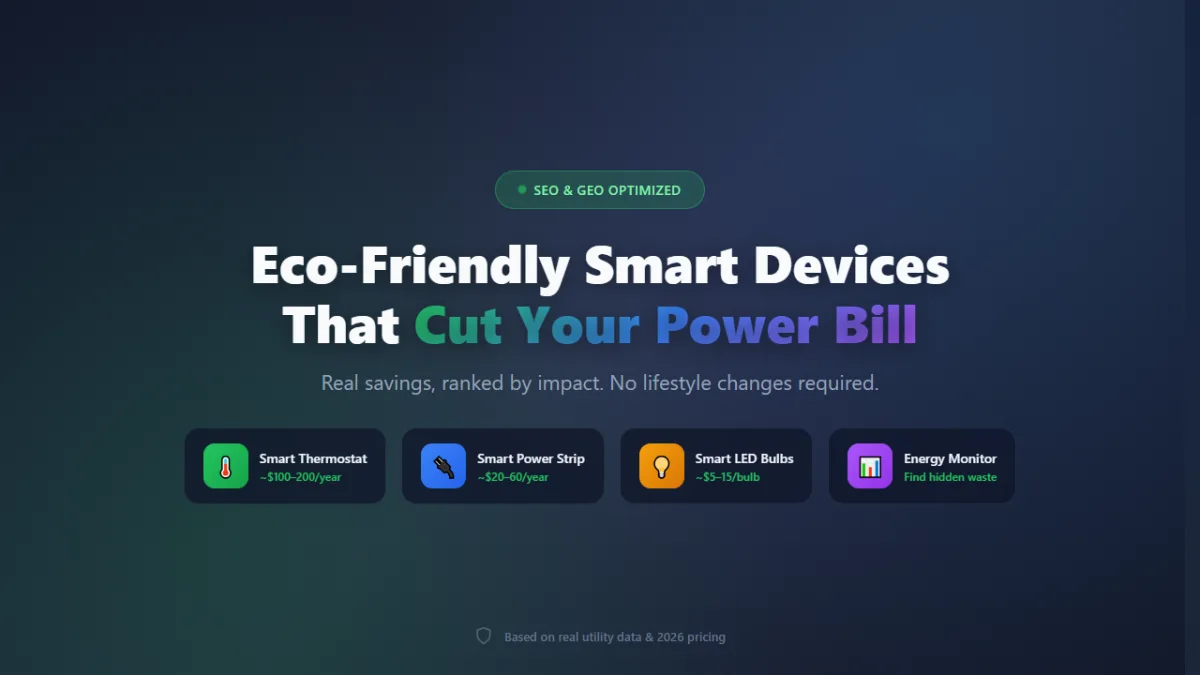
Most “smart home” gear is a solution looking for a problem. But a handful of devices genuinely pay for themselves by cutting electricity waste — no lifestyle changes required. Below are the ones that work, ranked by real-world savings potential.
1. Smart Thermostats — The Undisputed Winner
Typical savings: 10–15% on heating/cooling ($100–200/year for most US homes)
A Nest Learning Thermostat or ecobee doesn’t just let you adjust temperature from your phone. It learns when you’re home, when you’re asleep, and how fast your house gains/loses heat. Then it stops heating empty rooms.
Why it works: HVAC is 40–50% of the average home’s energy bill. Even a 10% reduction here dwarfs everything else on this list.
What to buy:
- Google Nest Learning Thermostat (4th gen) — Best learning algorithm, works with most systems, $279
- ecobee SmartThermostat Premium — Includes a remote sensor for multi-room balancing, built-in Alexa, $249
- Amazon Smart Thermostat — Basic scheduling only, but $80 and reliable if you just want set-and-forget
Installation reality check: Requires a C-wire (common wire) in most homes. If you don’t have one, budget $50–150 for an electrician or use the included power adapter (works ~80% of the time).
Pro tip: Enable “Eco Mode” or “Smart Schedule” and don’t override it manually for the first two weeks. The learning period matters.
2. Smart Power Strips — Kill Vampire Load
Typical savings: $20–60/year depending on your setup
“Vampire load” (standby power) accounts for 5–10% of residential electricity. Your TV, game console, soundbar, charger bricks — they all sip power 24/7.
A smart strip cuts power to peripheral outlets when the “control” device (usually the TV) turns off.
What to buy:
- Kasa Smart Plug Power Strip HS300 — 6 outlets + 3 USB, per-outlet monitoring, $50
- TP-Link Kasa KP400 — Outdoor-rated, 2 outlets, $35 (good for pool pumps, holiday lights)
- Emporia Smart Plug (4-pack) — $40 for four individual plugs, better if your gear is scattered
Real talk: Don’t plug your router, modem, or security cameras into the controlled outlets. Put them on the “always on” sockets.
Best use cases: Entertainment centers, home office setups, gaming rigs. Skip it for kitchen counters — the savings don’t justify the hassle.
3. Smart LED Bulbs — Only If You’re Bad at Switches
Typical savings: $5–15/year per bulb replaced (vs. incandescent), near-zero vs. dumb LEDs
Here’s the uncomfortable truth: a dumb LED bulb uses the same electricity as a smart one. The savings only appear if you currently leave lights on because you’re forgetful, or if you replace ancient incandescents/halogens.
When they make sense:
- Hallway/bathroom lights you constantly forget to kill
- Outdoor fixtures on schedules (dusk-to-dawn beats motion sensors for reliability)
- Lamps without wall switches
What to buy:
- Wiz A19 (4-pack) — $35, no hub needed, works over Wi-Fi, decent app
- Philips Hue White (4-pack + Bridge) — $100, most reliable mesh network, expensive
- IKEA TRÅDFRI — $12/bulb, needs their gateway, surprisingly solid
Don’t bother with: Color-changing bulbs for energy savings. The RGB diodes add cost and complexity for zero efficiency gain.
4. Smart Water Heater Controllers — Hidden Giant
Typical savings: 10–20% on water heating ($50–150/year)
Water heating is typically the #2 or #3 energy hog in a home (15–20% of total). Most tanks keep 40–50 gallons hot 24/7, even while you sleep or work.
A controller like Aquanta or Rheem EcoNet learns your usage patterns and only heats when needed. Some utilities offer $100–300 rebates — check yours first.
Caveat: Only works on electric tank heaters (not gas, not tankless). Installation requires basic plumbing/electrical comfort or a pro ($150–300).
5. Smart Blinds/Shades — Niche but Real
Typical savings: 5–10% on cooling in hot climates ($30–80/year)
Automated cellular shades block solar gain in summer and add insulation in winter. The motor uses negligible power.
What to buy:
- IKEA FYRTUR/KADRILJ — $150–200 per window, battery-powered, Zigbee (needs DIRIGERA hub)
- Lutron Serena — $400+/window, pro install, rock-solid reliability
- DIY: SwitchBot Blind Tilt — $70, retrofits existing horizontal blinds, good for renters
Reality check: Payback period is 5–10 years. Buy for comfort/convenience, not ROI.
6. Energy Monitors — The “Fitbit for Your House”
Direct savings: $0. Indirect savings: whatever behavior change you make
Devices like Sense, Emporia Vue, or Eyedro clamp onto your main panel and show real-time usage per circuit (with varying accuracy).
They don’t save energy themselves. But seeing “the dryer costs $1.20 per cycle” or “the old fridge in the garage costs $45/month” changes behavior.
What to buy:
- Emporia Vue Gen 2 — $70, 16 circuits, no subscription, best value
- Sense Energy Monitor — $300, ML-based device detection, pretty app, subscription for advanced features
- Eyedro EHEM — $130, wired Ethernet, local data only (no cloud), privacy-focused
What Doesn’t Pay Off
| Device | Why It Fails |
|---|---|
| Smart plugs on low-draw items (lamps, phone chargers) | Standby draw is <1W. Payback > 20 years. |
| Smart ceiling fans | Fan motors use 30–60W. The “smart” part adds cost, saves pennies. |
| Smart sprinkler controllers | Water savings ≠ energy savings (unless you have a well pump). |
| Whole-home battery (Powerwall, etc.) | Arbitrage works only on time-of-use rates with high spread. Most don’t. |
The “Stack” That Actually Works
If you want maximum savings for minimum hassle, do this in order:
- Smart thermostat — Biggest single win, 2–3 year payback
- Smart power strip on entertainment center — $50, pays back in 1–2 years
- Energy monitor — Find your actual waste, not guessed waste
- Water heater controller (if electric tank) — Often subsidized
- Smart bulbs only where behavior fails — Hallways, exterior, kids’ rooms
Skip the rest until these are done.
How to Calculate Your Actual Payback
Annual Savings = (Device Cost ÷ Payback Years)
But real math needs your numbers:
- Pull 12 months of electric bills — Get total kWh and $/kWh (including delivery fees)
- Estimate device impact — Use the percentages above as starting points
- Factor rebates — Check
dsireusa.org+ your utility’s website - Add install costs — Pro labor changes the equation fast
Example: 12,000 kWh/year × $0.16/kWh = $1,920/year. A Nest saving 12% on HVAC (45% of bill) = ~$104/year. At $279, that’s 2.7 years. With a $100 utility rebate: 1.7 years.
A Note on “AI-Optimized” Claims
You’ll see marketing about “AI-powered energy optimization.” Most of this is scheduling + basic occupancy detection. True ML (like Sense’s device detection or Nest’s thermal modeling) helps, but the hardware determines the ceiling. A dumb thermostat with a good schedule beats a “smart” one you never configure.
Bottom Line
Three devices cover 80% of achievable savings for most people:
- Smart thermostat
- Smart power strip (entertainment center)
- Energy monitor (to find the weird stuff)
Everything else is comfort, convenience, or diminishing returns. Start with the thermostat. Measure. Then decide what’s next.
FAQ
Q: Do I need a hub (Zigbee/Z-Wave/Matter)? A: Wi-Fi devices work fine for 5–10 items. Beyond that, a hub (Hubitat, Home Assistant, Aeotec) reduces congestion and works offline. Matter over Thread is the future — but 2026 hardware support is still spotty.
Q: What about renters? A: Smart thermostats (if you swap back at move-out), smart plugs, SwitchBot Blind Tilt, and portable energy monitors (Emporia Vue with clamp sensors) all work without permanent changes.
Q: Will these work during internet outages? A: Thermostats and power strips keep their schedules locally. Bulbs and blinds vary — check for “local control” or Matter/Thread support. Energy monitors with local logging (Eyedro, Emporia) keep recording.
Q: Are there privacy concerns? A: Cloud-connected devices send usage patterns to manufacturers. If that bothers you: Home Assistant + local-only gear (Zigbee/Thread/Matter), or Eyedro for monitoring. Read privacy policies before buying.

admin


Leave a Comment